
The Social Media Revolution Is Over. It Never Met the Promise.
Eleven years after the social media revolution, who really benefited?
In 2015, Erik Qualman’s Social Media Revolution 2015 video, drawing on his bestselling book Socialnomics, captured the excitement around social and mobile technology. The premise was compelling: social media would fundamentally change how people and brands communicate.
Eleven years later, it certainly has changed communication. But did it deliver the promise? What began as a way to connect and share information has evolved into one of the largest advertising businesses in history. We didn’t eliminate the middleman. We created a much bigger one.
Follow the money
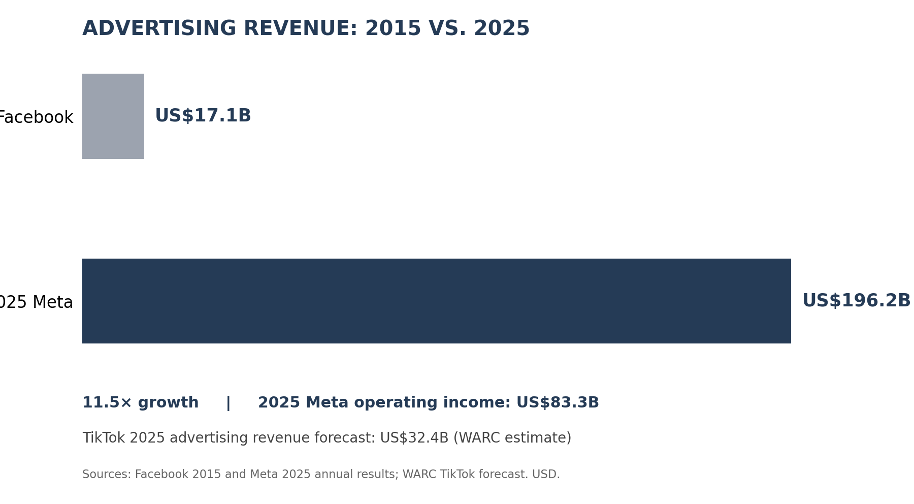
In 2015, Facebook generated approximately US$17.1 billion in advertising revenue. By 2025, Meta generated approximately US$196.2 billion, more than eleven times as much. Its 2025 total revenue was approximately US$201 billion, with advertising contributing about 98%.
Meta is the parent of Facebook, Instagram, WhatsApp and Messenger. Instagram was already part of Facebook in 2015. Meanwhile, TikTok emerged as another enormous competitor. Industry research firm WARC forecast approximately US$32.4 billion in TikTok advertising revenue for 2025; that figure is an industry estimate, not an audited company result.
This is an extraordinary commercial success. But commercial success and consumer empowerment are not the same thing.
Who controls the conversation?
Social media offered direct access to audiences without traditional media gatekeepers. Businesses built communities, consumers shared recommendations and friends connected. Then algorithms increasingly determined which content received visibility.
Organic reach became harder to rely on. A follower was no longer a guarantee of an impression. Marketers increasingly paid to reach audiences they had spent years building. Algorithms optimize multiple objectives, including engagement and revenue; they are not simply neutral chronological delivery systems.
The social media revolution did not disappear. It was monetized.
What about the consumer?
Many users complain that feeds show fewer updates from friends and more recommendations, sponsored posts and content they did not request. Yet social platforms remain widely used. People still value connection, entertainment and information, even when they dislike the delivery model.
Topic-based communities such as Reddit show the continuing appetite for conversation and research. Reddit also has advertising and moderation, so it is not an entirely uncontrolled alternative.
The next gatekeeper
AI now promises to change how consumers find information, evaluate offers and make decisions. Even Qualman’s current professional speaking topics extend into AI, innovation and digital leadership.
What happens when consumers no longer need to browse a feed or open an advertising email to discover something relevant? If social media monetized attention, AI could increasingly mediate or remove the human attention on which advertising depends.
That is the question for Part 2: The AI Revolution: When Consumers Stop Looking at Advertising.
References
Erik Qualman Social Media Revolution 2015
Facebook 2015 financial results
Socialinsider Social media benchmarks
WARC TikTok advertising outlook